
RAMIRO MENESES
Drawing to Become Again
By: Felipe Garavito Muñoz:.
Director / Curator
EL LABORATORIO – Art with Meaning
The artistic practice of Ramiro Meneses finds in drawing a profoundly intimate territory. His graphic work turns its gaze toward an equally complex landscape: that of identity, memory, and human experience. Where others observe the world, his drawings reveal the individual who inhabits it…
Widely recognized for his career as an actor and creator across other disciplines, Meneses has, in parallel, developed a graphic language that moves beyond the academic conventions of drawing to become an everyday exercise in thought. His lines are not conceived with the intention of illustrating a story; they are the story itself unfolding on paper. Each line records an instant of awareness, an emotion, a character, a doubt, or a memory that finds in drawing its most immediate form of existence.
This body of work acquires a singular dimension through the very nature of its supports.
Fragments of film scripts, pages from old screenplays, papers found throughout his everyday journeys, and cassette covers that accompanied different stages of his personal and professional life cease to be utilitarian objects and become surfaces for creation. Upon them, the artist constructs a new narrative in which the material memory of cinema, television, cooking, and music enters into dialogue with the spontaneity of contemporary drawing.
Each fragment of paper preserves traces of a previous story. The scripts contain characters already performed; the cassettes hold music associated with specific periods; and the found papers carry with them the anonymity of other lives, whether imposed or narrated.
The artist intervenes in these remnants not to preserve them as archives, but to activate new possibilities of meaning. Drawing thus emerges as a second form of writing that re-signifies the first, transforming biographical documents into works of art.
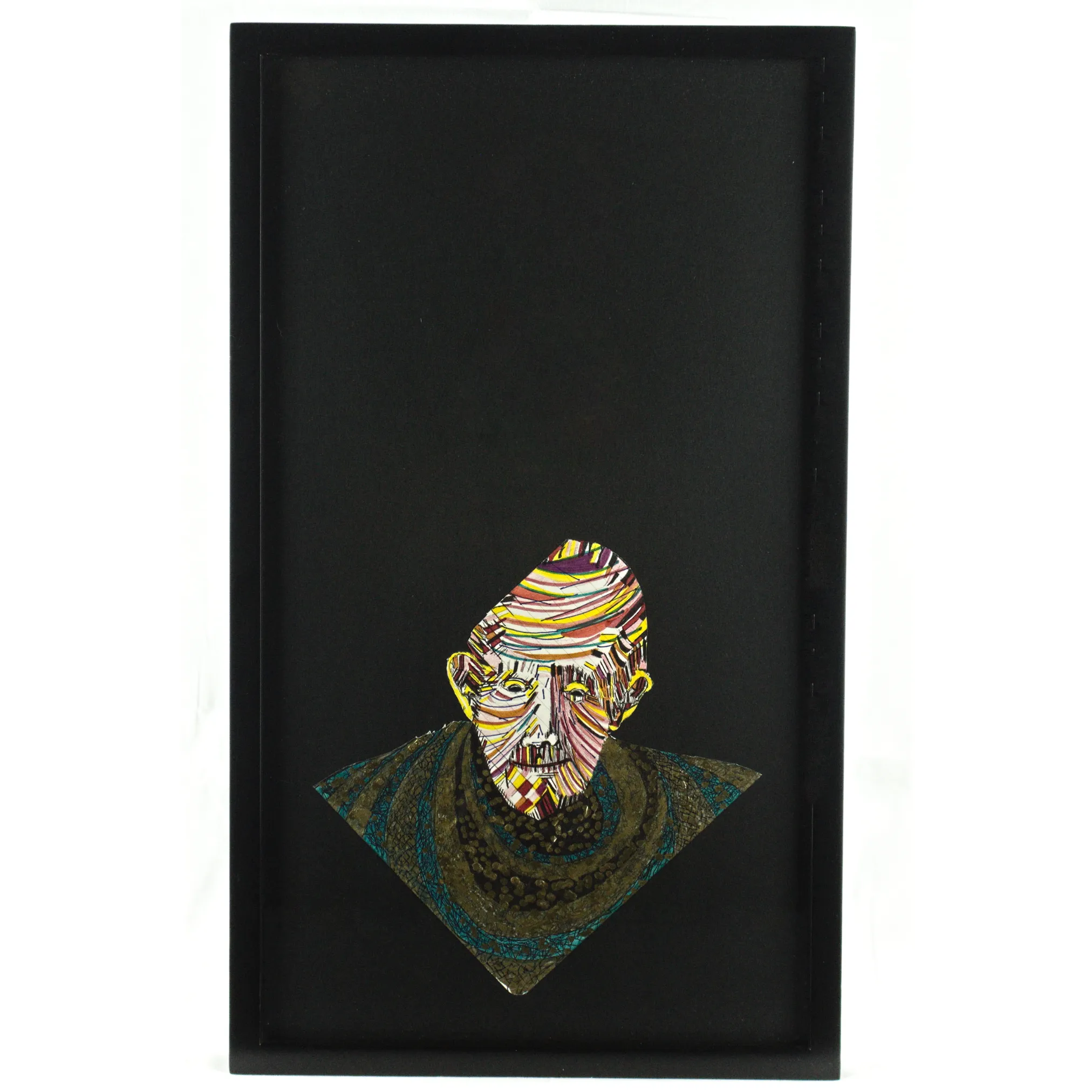
His characters emerge through an economy of means that privileges expressive force over faithful representation. Distorted faces, fragmented profiles, unsettling gazes, and barely suggested anatomies construct a gallery of beings that seem to oscillate between psychological portraiture and fiction. There is no interest in reproducing outward appearance; what manifests instead is the emotional intensity condensed within each stroke.
In this sense, the work enters into dialogue with some of the most significant traditions of contemporary drawing, in which the line ceases to function as a descriptive instrument and becomes visible thought. The rapid gesture, the embraced mistake, the spontaneity of the sketch, and the freedom of the stroke shape an aesthetic that privileges process over finish and experience over formal perfection. Each drawing preserves the vitality of the instant in which it was created.
There is, moreover, an autobiographical dimension running throughout this entire body of work. Meneses himself has remarked that, outside the private sphere, much of his existence is spent inhabiting characters, representing other lives, and not being himself. The actor permanently coexists with other identities, borrowed voices, and emotions constructed for the stage and screen. Drawing therefore appears as the place where that performance comes to an end, offering refuge to the pure expression of his own being. It is the space in which the character disappears and the individual emerges; where the mask finally finds a moment of silence.
Thus, each sketch can be understood as a page from a visual diary—not one that recounts events chronologically, but one that records states of consciousness. His drawings operate as emotional annotations, fleeting thoughts, and records of an intimacy that could scarcely be expressed through words. They are fragments of a personal form of writing in which the line takes the place of verbal language and gesture replaces narrative, speaking entirely for itself.
Rather than illustrating a life devoted to acting and the beings that have inhabited it, Meneses transforms that experience into raw material for a visual investigation into identity and its characters—into his own life, which seems to contain traces of all those he has once portrayed, but also of those he has observed, imagined, heard, or simply felt.
Between memory and fiction, between the actor and the draftsman, a graphic universe emerges in which every face constitutes a possibility of being. It demonstrates that drawing remains one of the most honest languages of contemporary art: within its apparent immediacy lies a profound reflection on the human condition, memory, and the construction of the self. Each line is an unrepeatable trace, each support an archive given new meaning, each character a fragmented mirror in which the artist finds, for a few brief moments, the possibility of simply becoming himself again: Ramiro…

PHOTOGRAPHY
Moment
CV
Discover